
How common are twins in Australia?
How often twins happen here, why the rate has stayed steady for more than a decade, and what sits behind the numbers.
The short answer
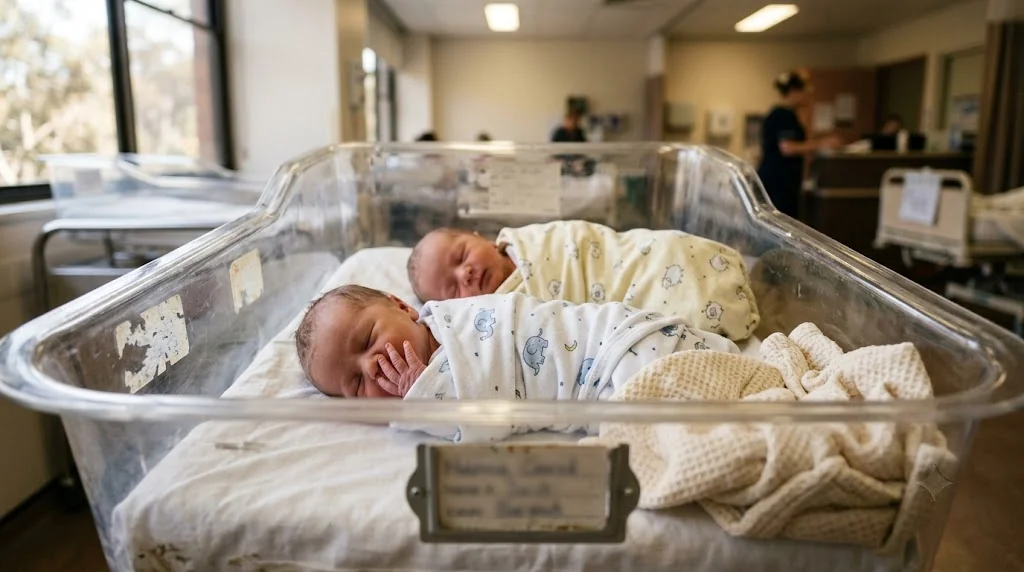
Twins are uncommon, but not rare. In 2023, 2.9 per cent of all births in Australia were multiple births, which came to 8,362 births in total (AIHW, 2023 data). Put another way, a little under three births in every hundred bring more than one baby home.
Almost all of those are twins. The same AIHW reporting shows 98 per cent of multiple births were twins, with the small remainder being triplets or more. Higher-order multiples do happen, but they are the exception within an already small group.
A rate that has held steady
The headline figure has barely moved. The multiple-birth rate has stayed relatively stable at around 2 to 3 per cent of all births since 2011 (AIHW, 2023 data). For a statistic that touches so many families, it is a quietly consistent one.
The Australian Multiple Birth Association frames the same reality from the parents' side, noting that twins and higher-order multiples account for around 1.5 per cent of all pregnancies (AMBA). The birth rate reads higher than the pregnancy rate because each multiple pregnancy delivers more than one baby.
Fraternal and identical, briefly
Twins come in two kinds. Fraternal twins, the dizygotic ones, come from two separate eggs each fertilised by a separate sperm, so they are no more alike genetically than any pair of siblings and can be different sexes. Identical twins, the monozygotic ones, come from a single fertilised egg that splits early on, which is why they share the same genetic material.
Fraternal twins are the more common of the two, though the exact split varies by population and is not something a single national figure captures cleanly. The distinction matters more for pregnancy and care than for the headline count, which folds both kinds together.
What sits behind the numbers
Two drivers come up again and again in the reporting. Assisted reproduction, such as IVF, is commonly cited as a factor in multiple births, and the broader trend toward later childbearing is another, since the chance of fraternal twins tends to rise with maternal age (AIHW, 2023 data).
These pull in different directions over time, which is part of why the overall rate has stayed so level. It is worth being measured here: the sources name these as drivers without pinning the whole picture on any single precise number.
The one-line version
Roughly one in every thirty-five births in Australia is a multiple, nearly always twins, and that share has held steady for well over a decade.
Who this series is for
A stable slice of Australian families raises two at once each year, and that is who the rest of this twins series is written for. If you are in that group, two babies means two of nearly everything, which is exactly where buying pre-loved earns its keep. The rest of the series covers the real cost of twins and how a twin pregnancy differs from a singleton.
References
Figures are drawn from national perinatal reporting and are for orientation, not clinical advice.
Related reading
Two of everything, for less
Twins double the gear you need. Buy it pre-loved, then sell it on when they move past it.
Shop the marketplace